Step 4: the recording
The drama will be recorded with actors either in an audio studio for a smooth and well controlled sound or on location eg a space that is not a purpose built recording studio to get a rougher, more dynamic sound. We normally record about half an hour of audio drama per day, but this varies. A standard BBC Radio 4 Afternoon Drama is usually recorded over 2 days.
Actors read directly from the script, so increasingly these days, they use iPads, as paper scripts can be noisy on mic. We often ask actors to be physical in performance, as the effort of moving impacts how they say their lines. So for example, if a character is meant to be rowing a boat, we would ask them so make a rowing motion with their arms, while they are speaking. Breath changes a great deal and the sensitive mics capture the sounds of a body in motion as well as speech.
In studio, we will also collect wild track – this is specific background sounds where we need human voices, but there is no script. So for example, if a scene is set in a Victorian market, we need actors to pretend to be 19th century marker traders and shoppers. Or we might have a scene set on a building site, to get the sense of builders working. These wild tracks are usually mixed in with other SFX from the sound designer’s database – these databases are huge, well over 40,000 SFX.
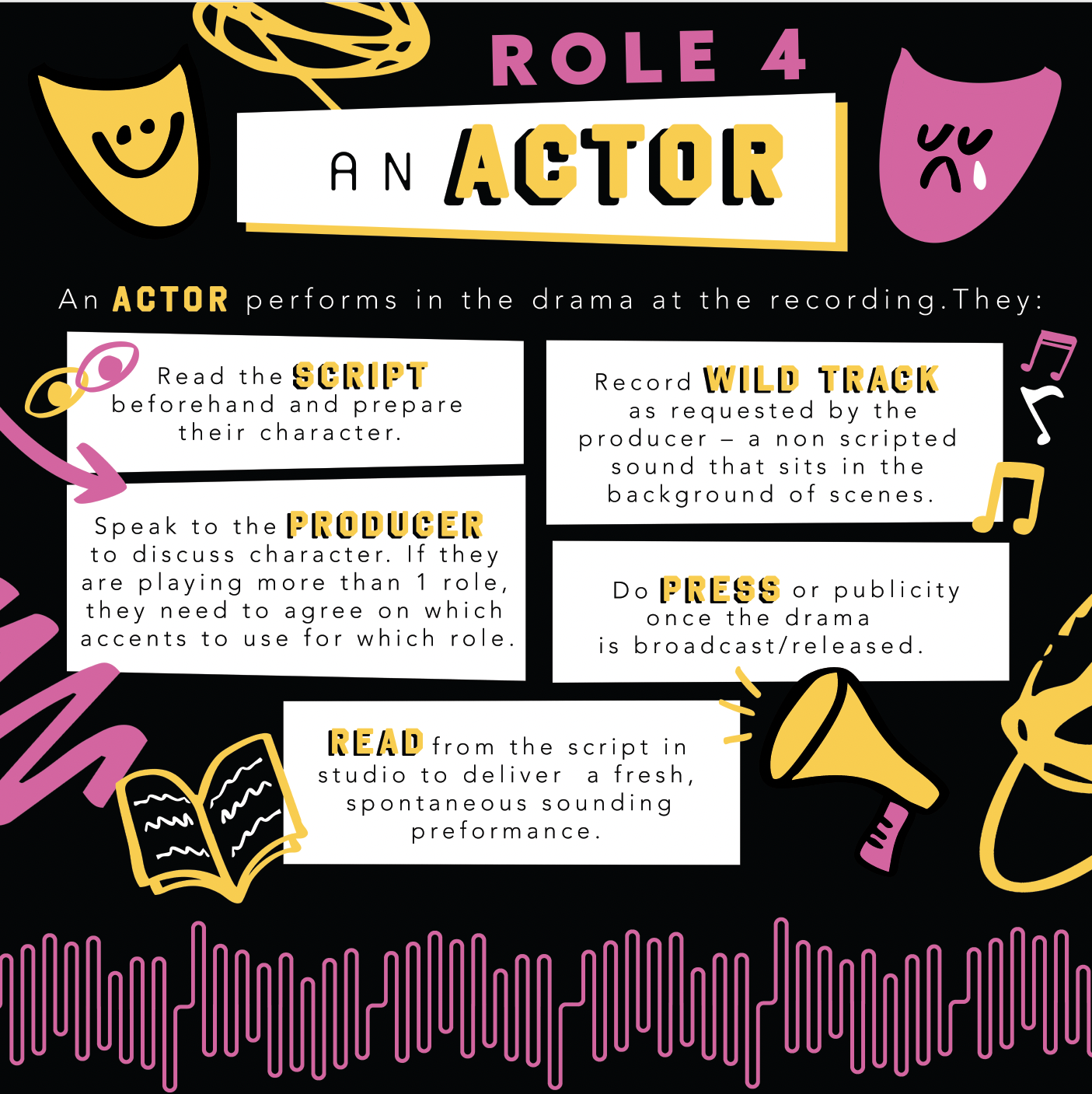
Role 4
An actor is the person who plays 1 or more roles in the drama at the recording. They:
Read the script beforehand and prepare their character
Speak to the producer beforehand to discuss character. If they are playing more than 1 role, they will need to agree on which accents to use for which role
On the day, arrive in good time
Read from the script and deliver a fresh, spontaneous sounding performance
Record wild track as requested by the producer – this is non scripted sound that sits in the background of scenes
The actors may be asked to do press or publicity once the drama is broadcast/release.